screenshot

Ideas

May 06

Creative Redemption

redemption_signA few years ago, a friend and I decided to make proper use of a mid-week day off, and travel to a nearby beach town. Because of the timing of our visit and the fact that it was mid-week, everywhere we went was eerily quiet. Walking down the main street we were greeted by the flashing lights and electronic sounds of games arcades, and we decided to visit one, to spend some of our hard earned two pence coins! As I walked into our chosen arcade, a big neon sign caught my eye, with the word ‘redemption’ on it. This was the cash desk where vouchers or tokens won on certain machines could be redeemed for cash. As I looked around a sadness hit me, as I saw many people playing on slot machines, people of all different ages, at about 11am in the morning. You could tell that for some this was a daily hobby, spending hours of time and lots of money in the hope that they would hit the jackpot and be able to make the journey to the redemption desk to exchange their winnings for something greater.

It made me think about how we all search for redemption in one way or another.

That sign has been on my mind again recently as I’ve explored what redemption might mean, a word we use a lot in ‘Christian-land’. We talk about God redeeming us, redeeming things, his redemption plan for the world. I’ve always thought about redemption in terms of being saved by God, that God has redeemed me, which I believe is true. But there is another meaning of redemption which I’ve perhaps neglected, one that takes me back to that slightly sad games arcade in that quiet beach town on my day off.

The second meaning of redemption is about gaining or regaining possession of something, normally in exchange for something else. So in that games arcade, you win tokens which you then exchange for real money. You give in what you have (or what you have is taken from you) and you receive something much better in exchange, something of a higher value. Something better than what you had before.

When I’ve lost things in my life or things have been taken from me – friendships, jobs, projects, whatever…it at times has felt unfair. People have often told me that God will, in time, redeem that situation, that I will get back whatever I’ve lost if I trust Him and wait. But what I’ve come to realise is that it’s so much better than that, and it goes right back to the very core of who God is; a massively creative creator, who is always pioneering new and amazing ways to restore, heal and bring people back to Himself.

Sometimes we don’t get back what was taken from us…we get something even better.

Take the story of Joseph (from the book of Genesis in the bible) as an example. I often imagine what Joseph must have felt like, being ripped away from his father, broken relationships with all his family, sold into slavery and thrown into prison. I wonder about those months and years that he spent in prison, with everything that had happened going round and round his mind. What did he think the redemption plan was? If it was me I would have probably imagined my brothers repenting, me being allowed to go back and live with my family, doing what I was doing before. What was God’s plan? Joseph became one of the most powerful men in Egypt, he saved the lives of thousands of people preventing them from being killed by famine, and in the end his relationship with his family was restored. Wow. Do you think he ever even imagined that as he sat in prison, alone, with his life in shreds? At the end of the story when being reconciled Joseph says this to his brothers; “You intended to harm me, but God intended it for good to accomplish what is now being done, the saving of many lives” – Genesis 50:20

Or Job. Job literally had everything taken away from him apart from his life. Through all his pain and questioning he never lost faith in God. At the end of his story we are told that ‘the Lord restored his fortunes and gave him twice as much as he had before’ – Job 42:10.

Or Moses. Because of a stupid mistake Moses went from being the son of a Pharaoh to a shepherd tending sheep in the wilderness. He lost everything. But it was Moses that God used to set the Israelites free from slavery. That’s kind of a big deal.

The bible seems to be full of people who in their loss, in their mistakes, in their grief, trusted God and waited, and out of that came a redemption plan that reached so far beyond their own imaginations. Greater purposes came from those messy situations, where what was taken or lost got replaced with something so much greater, something that stretched so far beyond meeting their own needs into meeting the needs of others.

When things are broken we can try to fix them so that they become exactly what they were before. We can see redemption as getting back what we had before and nothing else. But sometimes we need to just put the broken pieces in the hands of God, trusting that He, as the ultimate and most incredible creator we know, will take those pieces and make the most beautiful mosaic, something that will reach out and bring purpose, destiny, healing and redemption not only to our own lives, but to the lives of many other people.

I love this so much about God. That His creativity is not limited to the earth and the things He has made or done in the past. He is endlessly creative in the ways He engages with us; His provision, His interaction with us, the way He brings healing and restoration, all done differently for each individual, a masterpiece He paints differently for each of us. Even His redemption is creative beyond our comprehension, beyond anything we could ask or imagine in our wildest dreams.

“When you sow, you do not plant the body that will be, but just a seed, perhaps of wheat or of something else. But God gives it a body as he has determined, and to each kind of seed he gives its own body” – 1 Corinthians 15:37-38

We can be like seeds that get crushed. But it would be ridiculous to try and gather all the tiny parts of a seed and try to put it back together again, as it was before. We would know that this brokenness, the crushing of the seed, put in the right hands and given the right care, can grow into the most incredible tree, that brings life, fruit and shelter to many others for years to come.

I want to be able to trust that God, the first and ultimate artist, is the one who determines what kind of plant the crushed seeds of my life will become. What a relief, because every time I have had a plan in my head and I’ve finally let it go and let God take control, what grows is mind-blowing, overwhelming, something I never could have predicted or created.

It actually makes my own plans look ridiculous.

That is creative redemption, and day by day I am absolutely loving seeing it happen in my own life, and in the lives of others.

0
comments

Feb 16

You Restored Me

Well who’d have thought it?
In the midst of all of this shit I’d find my perfect fit
Rescued from the pit and now God this is it
My destiny calling no more tripping and falling
No more hearing “her behaviour’s appalling!”
You see now I’m determined to live for Your glory
And tell the whole world this amazing story
Of how at my darkest you saw me
And you didn’t ignore me.
God, You restored me.
And even now you go before me.
Yeah You’re the one that healed my heart
And now I’m here with this brand new start
And these words only help me express it in part
What You’ve done and who You are
Rescue, restore, redeem, repeat
Yeah you helped me get back on my feet
When I’d accepted defeat, when I was all but beat
When I was shattered and battered and calling retreat
When my heart was open and I was bleeding broken
And I cried out for help but there was just no one
The shame, the blame, their ridiculous claims
Took things from me I thought I’d never regain
And I reached my darkest
But You saw me. And you didn’t ignore me.
God You restored me.

0
comments

Jan 24

Silence

Why do I hide from the silence?
Because in the silence I find you.

It’s like this mirror that’s held up to me
And most of the time I don’t like what I see
So I duck and I dive and I run and I flee
Well that’s better than facing my inadequacy.

Why do I hide from the silence?
Because in the silence I find you.

It’s like this light that shines in my dark
Revealing the bitterness and pain in my heart
And all the ways that I miss the mark
And how I constantly need to restart.

Why do I hide from the silence?
Because in the silence I find you.

It’s not just the bad it’s the good stuff too
Everything you are and everything you do
It overwhelms me and if I took it all in
Well I know it’d change everything.

So why do I hide from the silence?
Because in the silence I find you.

This world it creates so much noise
With all our technology, gadgets and toys
Staying plugged in is an easier choice
Than to act on the challenge that comes from your voice.

Why do I hide from the silence?
Because in the silence I find you.

0
comments

Dec 28

New Year

The-Future-Is-Exciting

I always get super excited about New Year. I’m not a huge fan of the overpriced drinks, overcrowded nightclubs and unrealistic resolutions people set for themselves, but there is one reason for my excitement that has been the same now for ten years.

Nine years ago, a brilliant friend and I got together one new years eve, to eat nice dinner and hang out. We started talking about our year, reflecting on the things that had gone badly and the things that had gone well. We started talking about the things we wanted to achieve over the coming year, and we decided we would write ten of those things down on a piece of paper, put them in envelopes and give them to each other to keep safe until the next year, when we would open them and see how many we had managed. We thought it would be cool to include a message to ourselves, something we thought we’d need to tell ourselves a year on, perhaps something we might forget that we’d need to be reminded of. That’s exactly what we did, and we’ve done it every year since.

photoThis year I found all the old envelopes and it was amazing to look back at ten years of me – all my hopes, dreams, and disappointments. Every year it is such a profound and moving experience, and is one that I can’t recommend highly enough. So I thought I’d tell you about it.
One of the most fascinating things has been seeing how the targets I set for myself have changed. The first few years I set myself such stupid, unrealistic goals. My targets were vague, generic, non-specific and I’d need to be a superhero to get close to achieving most of them! As I’ve got a little older I set goals that are more realistic – or to quote to the well-known goal setting acronym ‘SMART’, my goals are specific, measurable, achievable, realistic and time sensitive. Sometimes I set goals that I know I will achieve. For example a couple of years ago I set the goal that I would have an MA in Applied Theology. I didn’t plan on failing my MA, but there were no guarantees – I had to work hard to finish it and it was still a massive achievement worth marking and celebrating. Some targets are things I’m pretty sure will happen, others are things I have no clue about, and some are targets I know may be on there for a few years yet.

There has also been a switch in priority for me. The first few years were all about the outcomes, the numbers, how many goals I could tick off and what number out of ten I had achieved. This year I didn’t even count the ones I had managed to do, but I reflected a lot around the person I had become, how I had grown and changed whilst trying to achieve those things. I don’t measure success now by my achievements, but in whether I am becoming more like the person I believe God wants me to be.
My favourite part is definitely the message I write to myself. It sounds like a slightly weird thing to do, a bit like talking to yourself, but it’s actually a bit clever. If you think about it, apart from God, there isn’t a person in the world who knows you better than yourself. You know what you struggle with, what you can be a bit lazy with, the things you forget and need to be reminded of, and what refocuses your heart and mind. So who better to be challenged and encouraged by, than yourself? It’s often a tool used in therapeutic situations, for example where someone might be encouraged to write a letter as an adult to themselves as children. It helps them reflect on what they might have needed to hear at that point in their lives, who they were and who they are now in comparison. You’ll see athletes psyching themselves up before the big game and even in the psalms we see David telling his soul to wake up! (Psalm 57:8)

It’s also fascinating that despite being adamant at the time that you will remember what you’ve written down, a year later I guarantee you will have forgotten nearly all of it. I can sometimes remember one or two of my targets, or maybe a sentence in my message to myself, but there are always surprises.

Finally the most important thing it does, is to help me remember how faithful God is, and how He has never ever failed me. Last year when I wrote my targets I was in a bit of a weird place, recovering from a painful year and making some big decisions about where I should be and what I should be doing. To open the envelope this week left me stunned, as I could see the place I was at, the things I was thinking when I’d written it all and how God has used every inch of it to bring me to where I am today. I can see His genius plan throughout all ten years of those hopes, dreams and questions, even when it’s been tough or hard to understand. Those pieces of paper are my markers, my evidence of God at work in my life and I will keep and treasure them forever.

So whatever you are doing this new year, I would really encourage you to find someone who knows you really well, and give this a go. Even my hairdresser and her sister are trying it out this year! If you don’t feel comfortable doing it with one other person why not do it with a group of young people you work with, your small group, a team at work or your family? I guarantee it will be a worthy use of your time, and maybe even like me, you will find it quickly becomes your favourite Christmas/New Year tradition.

0
comments

Dec 20

I See Miracles

This one’s for all you festival fakers.
You spiritual high chasers and miracle makers.
Now I know you’ll write me off as a liberal,
Say I’m a little over critical even verging on political
But I see miracles.

Now I’m not disputing what you say you’ve seen
Not saying you’re too keen not trying to be mean.
But I’ve sometimes seen that what we think is mystical
This weird metaphysical is nothing but egotistical

I see miracles.

Not in the stadium shows or front church rows,
Or preachers who teach us how prosperity grows.
Or hyped up, psyched up emotional groans,
Or prophets and healers sitting on thrones.

I see miracles.

In the single Mum with three kids to feed,
Failed by a system of unspeakable greed,
Who chooses work instead of weed,
Despite her need she will succeed.
Or the teenage lad without a Dad,
Who sticks at college when it makes him mad.
Or the bomb blast survivor confined to a chair,
Who’s forgiven her attackers, shocked they just stare.

Greater things than this you’ll see
I know who said it but what did he mean?
The promises on God TV?
Or real people, you and me?

So this one’s for all you festival fakers
You spiritual high chasers and miracle makers.
Now I know you’ll write me off as a liberal,
Say I’m a little over critical even verging on political
But I see miracles.
Yes I see miracles.

0
comments

Nov 29

Making Mistakes

This article was originally written for and published in the July 2012 edition of Youthwork Magazine.

Ouch.

Whoops. It’s a word I must have used thousands of times in the ten years I have been doing youth work. In the early days I used it probably on a daily basis, with the hope that as I grew in experience and got my youth work degree, I would say whoops, a lot less. Perhaps I make less of the more obvious mistakes now, but I still make mistakes. Whether I like it or not, whoops is still a regular part of my vocabulary.

The mistakes I have made have varied from small organisational errors and badly handled conflict, to deep-seated bad attitudes and reactions to unhealed hurts. Some of these mistakes are funny to look back on and would feature comfortably in an episode of ‘You’ve Been Framed’. Some of them have been painful and costly and are really not very funny at all. But as I look back I realise that whatever those mistakes were, they have shaped me as a youth worker and made me the person that I am. They have helped me to realise not only the importance of making mistakes, but the deeper importance of learning from those mistakes.

Mistakes are always messages. At a youth project I worked in a few years ago, I had faced months of difficult conflict with a group of young people. I had been insulted, threatened, spat on, pushed, had bags of dog excrement thrown at me…for months and as I was the senior worker I always had to deal with any kind of trouble. One night despite every effort on my part to engage these young people and build a positive relationship with them, they went beyond what I was able to cope with, and as my staff and the young people were in danger I was forced to call the police. When they arrived 45 minutes later, one police officer spoke to me very badly, saying I should have dealt with the situation myself and was wasting his time. I lost it. The people that were supposed to be helping and protecting me were now angry with me for asking for their help. The conversation developed into a nasty argument and in full view of young people and staff I lost my temper, shouted and swore at the policeman, who threatened to arrest me. Thankfully a colleague took over and forced me to go back inside. As I sat on the floor in the staff toilet with tears streaming down my face hoping I wouldn’t be spending the night in a police cell, I realised what I had done and I wished I could erase the last ten minutes. But I couldn’t.

Whoops.

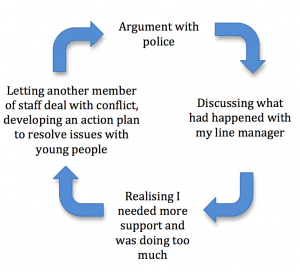
Later that week as my amazingly supportive line manager and I sat down to talk about what had happened, we realised some problems that we just hadn’t seen before. I was doing too much, the problems with these young people were not being resolved in any way, I was the worker dealing with it on a weekly basis without any support and I was completely exhausted. I had acted unprofessionally and should not have said what I said, but the mistake told us things, pointed towards areas that needed attention, helped us improve the situation. The mistake had a message and thankfully we heard it.

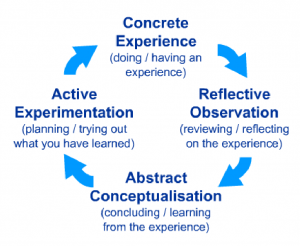
A simple reflective practice strategy can help us make sense of a mistake. Kolb (1984) developed a cycle that can be useful in helping us reflect and learn from an experience. I include my mistake to show you how it might work;

A mistake nearly always forces you to look at the determining factors that led to the mistake. In my example I acted badly and I needed to be disciplined for that, but there was also some responsibility that needed to be taken by my co-workers for not supporting me, my line manager who hadn’t spotted I was doing too much and of course the policeman who perhaps didn’t handle the situation in the best possible way! When someone makes a mistake it can be because they’re too tired, perhaps they are juggling too many things or don’t have the adequate training to deal with a certain situation. If someone you are managing makes a mistake what can you take responsibility for? What can you improve on and what can be changed to ensure the mistake won’t happen again?

When I was 15 I attended a house group that was always the highlight of my week. It was a safe space for me to ask questions, share difficulties and explore God with other people my age, as well as with incredible youth leaders. One night, one youth leader shocked me to my core as she honestly and humbly told us about a mistake she had made in her teenage years. It was something that had deeply affected her, and her marriage.

Whoops.

I couldn’t believe she had done it! I thought she was perfect, holy, a youth worker…not someone who made a huge mistake like that. I didn’t know what to say and as I walked home I felt disappointed that the youth leader I had looked up to so much, was actually just a normal person like me who made stupid mistakes. What a brilliant lesson for me to learn! As I continued to navigate my way through adolescence, I realized that messing up was normal and that I didn’t have to keep it a secret. I no longer saw my youth leader as some perfect role model who I could never be like, but someone just like me, who messed up and needed God. Tell your young people about the mistakes you’ve made, and the mistakes you still make. Obviously respect boundaries, be appropriate and don’t glamorize or belittle sin, but don’t let them think you are something you are not. Young people need to know that people screw up and make it, young people need to know that they are not expected to be perfect and that leaders are not to be put on pedestals, because they have a habit of falling off quite spectacularly. It’s not just young people that need to know this – it’s people in your church, your best friends, your staff and your volunteers. Sharing your mistakes stops people from thinking you are something you are not, relieves you of impossible pressure or expectations and may even prevent someone else from making the very same mistake you did!

It is a myth that Christians never make mistakes. The bible is full of not good enough people who screwed up all the time, that God used and empowered. Peter is often famous for his mistakes – losing faith whilst walking on water, cutting off a soldier’s ear, that whole denying Jesus three times thing.

Whoops.

But after all that, who did Jesus use to build his church? Was it the disciples who got it all right, the ones who gave all the right answers, didn’t ask as many questions and kept their sword in it’s sheath? No, it was Peter he chose. Peter the mistake maker. Peter might have made mistakes but at least he tried. He tried to defend Jesus, he was actually present at the crucifixion, he got out of the boat! He did things, he acted, his beliefs led to him doing. I would rather be someone who makes hundreds of mistakes trying to do something than someone who makes no mistakes doing nothing.

Pioneer ministry is a fairly new term within youth ministry but it’s important to mention it here because mistakes are inevitable in pioneering. Pioneer youth ministry is doing stuff that hasn’t been done before, carving out a new path that has never been walked. There is something essentially pioneering about all youth work, because every relationship you form is a new path, every individual you meet and work with will have totally different needs and responses compared to another. You are constantly pioneering, constantly guessing what will work and not work, what to say and not say, how this person will react to that. There are no maps, no senior workers to advise you or tell you about their mistakes so you don’t make the same ones. If it’s truly pioneering then trying it with a bit of guess work is the only way. Mistakes will be made, because they are the only way you can be lead to something that works, a path that’s walkable that others can follow. In his development of the lightbulb, Thomas Edison famously said, ‘If I find 10,000 ways something won’t work, I haven’t failed. I am not discouraged, because every wrong attempt discarded is another step forward’. It is the destiny of a pioneer to find thousands of ways that don’t work, all so that they can be lead to the one way that will work. Your mistakes will always be the paving slabs the path leading to your successes is made from.


Sometimes it’s hard trying to imitate a sinless savior who in just thirty three years changed the course of human history and enabled a way for broken people to restore their relationship with God. I often feel like I’ll never get it, I’ll never be good enough, and how can Jesus ever understand that? He was perfect, he doesn’t know what it’s like to make mistakes. Or does he?

In Luke 2 we read an interesting story about Jesus as a young person, temporarily separated from his parents only to be found in the temple, listening to the scriptures, asking questions and amazing people with his knowledge. In verse 52 we’re told that ‘Jesus grew in wisdom and stature, and in favour with God and men’.

Really? Jesus grew in wisdom? Jesus could grow in something? Jesus wasn’t born with total and complete wisdom?

Then there is Hebrews 5: 8 – 9; ‘Although He was a Son, He learned obedience from the things which He suffered. And having been made perfect…’ Jesus learned things, Jesus was ‘made perfect’. So he wasn’t before?

I’m not trying to argue that Jesus wasn’t perfect or sinless, I believe he was both. But perhaps this is sometimes the problem in our thinking when we see making a mistake as a sin, rather than just a mistake, inevitable in the process as we learn and grow into the person God is shaping us to be. Making mistakes isn’t failing, it isn’t sinning, it can’t be if Jesus did it.

Jesus was fully human. He wasn’t born potty trained. He had to learn how to walk, to talk, to feed himself, to read, to write. He was a carpenter (or general handyman for the theologians amongst us). I have never trained to be a carpenter, but I did do GCSE Resistant Materials, which is almost the same thing and I was awful at it. It took me months to learn how to saw properly, make joints and hammer nails in the right places. Jesus would have been the same. He probably made some really dodgy tables, the ones where you need a couple of napkins under a leg to stop your dinner from flying off the table with every movement of your leg.

Whoops.

Although perhaps not entirely theologically accurate, I love the scene in ‘The Passion’, where a flashback shows Jesus inventing a high table, different to the others around at the time. It shows the side of Jesus we never see, the one who played and learned and grew, the Jesus who made mistakes and who therefore gives us permission to do the same.

0
comments

Sep 29

The Shell

One of the best pieces of advice I’ve ever been given, is that ideas you have now, are not always for now. Sometimes an idea needs time to grow, evolve, develop. It needs to be pruned and refined. It needs to be pulled apart and criticized by people who love you and understand the context of the idea. I love ideas. I have them all the time. Sometimes I have so many ideas they drive me insane. I am thankful for my ‘ideas’ notebook, which is filled with projects, dreams, film ideas and book plans. Some of those ideas have been done, some of them will get done and some of them may never happen. Ideas are fun.

I want to tell you about one idea, because it’s an idea I would like to be refined and pruned. It’s one of those ideas that won’t leave me alone, and I think that even though it’s kind of a big one, one day it might actually happen. It’s shaped from all the different parts of me – my experience as a youth worker, my love of art, film and creativity, my desire to see as many people as possible come to know and love God in a way that is meaningful and relevant to them…and my weird obsession with abandoned buildings and large empty industrial spaces (I once cried in the Turbine Hall in the Tate Gallery in London because it was so beautiful. It was empty). So here goes, drum roll please, introducing…The Shell.

( Read more )

0
comments

Sep 14

I Am Not Finished

This week I’ve been on a Bristol Centre for Youth Ministry Community Week, where students across all three years retreat to Wales to spend time with God and each other, as well as learning from some essential lectures! It’s been a great week as I’ve got to know the students a lot better, and something one of them said in a piece of liturgy they were reading out during a worship service has really stuck with me.

“God who created you, is still creating you”

The first thing God did was to create, the ultimate aspect of his character is a creative; an artist, painting and sculpting and shaping. As we are made in his image we are created to create.

Thanks to my lovely art teacher friend Anna for this photo of her beautiful classroom

The description of God as a creative being or artist is one that has resonated with me better than any other, particularly as over the last few years I have begun to explore more of my own creativity. I remember hearing Rich Mullins talk about how God is a wild man, not the cultured, civilized God we think. It’s this side of God that I am deeply drawn to, this creative, mysterious, wild, unpredictable, unexplainable force that knows me and loves me. Despite my quest for answers I have found God to be more present in the questions, in the mystery, in the unknown. This is where art belongs. It is always mysterious, sometimes slightly confusing or frustrating and yet it reveals so much of who we are, and who God is.

One of my favourite ever movies is a slightly odd film directed by Richard Linklater called ‘Waking Life’, where a teenager walks around having conversations with people trying to figure out whether life is real or whether it is a dream. The conversations he has are deep, mindblowing and challenging, ranging from theology to philosophy and everything in between. Each scene is a little movie in itself! One scene is two friends talking in a coffee shop;

“When I was younger, there was a desperation, a desire for certainty, like there was an end to the path, and I had to get there.”

“I know what you mean because I can remember thinking, ‘Oh, someday, like in my mid-thirties maybe, everything’s going to just somehow gel and settle, just end.’ It was like there was this plateau, and it was waiting for me, and I was climbing up it, and when I got to the top, all growth and change would stop.”

I remember watching that at the time feeling that I was in that younger stage, of chasing and striving to become what I would be, and that one day I would reach this point where I had ‘made it’ and I would be able to relax and just live my life as this finished person.

Due to lots of learning and change over the last couple of years, I do feel there has been a ‘settling’ of sorts. A kind of letting go, or at least an acceptance that this is who I am, this is my life now and who I am now is pretty much who I will be forever. Although this has been freeing in some ways, it is also disappointing. Despite the circumstances in my life being great at the moment this thought has bothered me continuously over the past few weeks.

It’s disappointing because there are so many things about myself I hoped would have changed by now; deep wounds, character flaws, unhelpful patterns of thinking and low self-confidence. Who I am is not who I hoped I would become, despite my best efforts. I thought by now I would be…better. The chase is over and I am not the person I dreamed I could be.

I’ve forgotten God isn’t done creating. I am not finished.

What a comforting thought, that who I am right now is not the end of my story. That God is still painting and sculpting and shaping and drawing and editing me…and that in his mind he sees his finished creation, a masterpiece he has crafted from dust. As if this wasn’t enough, even when I smear the painting or chip the sculpture, God just carves or paints it into something else. He endlessly recreates what others and I destroy.

It’s that ‘now and not yet’ metaphor. There are glimpses of God’s work in me, moments of genius and beauty, a deposit of what is to come, a sign of the future. But there are glimpses of corruption and pollution, devastation and evil, a reminder of the darkness that exists in the world, the war that I am a part of, raging within me. The now and not yet fight, as one kingdom tries to invade the other, and I am a mesh of both, a slimy caterpillar hiding in the cocoon of my partly finished physical form until I can burst out and fly away as the being I was born to become. Everything we see on this earth is only a partial glimpse and we will never be fully made, completed, until the end of this age.

This reassures me! I am not who I want to be, but I’m not who I was or who I will be. There is so much more God will do. Outwardly I am wasting away but inwardly I am being renewed day by day! (2 Corinthians 4:16)

God had an idea to create a masterpiece. God created me, and he is still creating me. He is editing and carving and painting and sculpting and molding and making and shaping and one day, I will be finished.

0
comments

Aug 30

The Lift Dance


In the first couple of weeks at my new job, I’ve had several moments of complete and total joy at what I’m actually getting paid to do. This has lead to what I will call – the lift dance. It goes a bit like this;

1) I find out something cool I get to do as part of my job
2) I feel full of joy and excitement but recognize that I may lose my job or traumatize my new colleagues if I fully express this joy and excitement
3) I have to go in the lift at some point during the day to go somewhere awesome like the library (there is a basement library with a vault that has some super old books in that smell amazing)
4) I remember that no one can see me in the lift (the rumours of CCTV are false)
5) I do a silly dance and fully express my joy and excitement at everything God is doing and the life I get to live

When I sit and really let myself think about everything God has done for me, the way he’s turned everything around…it’s overwhelming. It’s from this place that I try to start every day. Even when I’m grumpy, even when it’s early, even when there seems to be too much stuff to do, even when the sadness of the people I’ve lost in the last couple of years still stabs at me, I remember.

I remember what God has done for me. And when I remember it, there is always a reason to do the lift dance.

Sometimes as Christians I wonder whether we are too keen to forget, to press forward, to move on. We are so focused on the future that we forget to reflect on the past and let it revolutionize the present. The journey we’ve been on, the road God has weaved for us and walked with us.

It’s too easy to forget.

The Israelites were good at forgetting. It wasn’t long after they had been delivered from Egypt that they forgot just what they had been saved from – a life of pain and slavery. They even wanted to go back! (Numbers 14:3). Even when they reached the Promised Land they forgot and started doing evil stuff (Judges 3).

Forgetting what God has done never seems to end well.

In the Old Testament, one method of remembering was to build a pillar or altar of stones (1 Samuel 7:12, Joshua 4:1-9). When God helps Joshua cross the Jordan river with the ark of the covenant, Joshua does just that, and tells the Israelites that in generations to come when their children ask what the stones mean, they can tell them the story of what God has done. I love imagining a little kid, hundreds of years later, being sat down and told the amazing story of God doing a total miracle.

Remembering is good for us, but it’s good for others too.

One of the last things Jesus did was teach his disciples something to help them remember. During the last supper Jesus broke bread and drank wine with them, telling them to “do this in remembrance of me” (Luke 22:19). All across the world, 2000 years later, we celebrate communion together as followers of Jesus. We stop and remember what Jesus has done for us on the cross. It’s always a powerful symbol, where perspective returns and gratitude ignites.

We need to keep building pillars of stones! For real, maybe. Symbolically, definitely. Some creative ways of doing this:

• Buy or find a cool glass jar, and put it somewhere in your house. Every time something awesome happens to you or someone in your house write it down on a bit of paper and put it in the jar. When the jar is full empty it out, get your friends and family round and read out everything in the jar over a bottle of wine.
• Keep a journal, or prayer diary. Split the pages in half and on one side write down what you’re praying about. When you feel like God has resolved it or answered your prayer, write down what happened next to it on the other half of the page.
• Write down your testimony on a bit of paper, photocopy it ten times, and see how creative you can get leaving it in random places. Doctor’s waiting rooms, train seat tray tables, underneath the windscreen wiper of a random car…you can have lots of fun with this!
• Tell your stories! Tell them to your friends, family, house group, church. Stories are so powerful, moving and untouchable. They’re useless if they remain inside of us. We must tell them.
• Do more lift dances. But check for CCTV first.

0
comments

Jun 08

Grace and Justice


I saw this image today and it’s added to some recent thoughts I’ve had about grace and justice. Sometimes I really struggle with how those two things sit together. On one hand God is so outrageously and consistently loving and gracious. We see this displayed so powerfully in the cross and in his relentless pursuit of us. But on the other hand God loves justice and the bible mentions justice a lot. God is just and he will one day bring justice in full and make everything right.

I find the same tension in how I treat others. When someone does something wrong, I feel a strong emotional reaction that they should face justice for it, that they should be made to pay for what they’ve done because that’s what justice is.

Except of course, if that someone is me.

So often we crave, thirst and fight for justice, for everyone except those we have wronged. We want to dish out justice, but we actually don’t want to receive it. We say we want justice, but do we really? Have we really thought about what might happen if we actually saw justice?

It’s important to say that sometimes we think justice and punishment are the same thing, but they are really not. True, Godly justice will restore, make things right, replace some of what’s been taken. In the Old Testament justice is often linked to the Jewish idea of Shalom – wholeness, peace, everything as it should be. In the justice system restorative justice seeks to do just that – restoration in both victim and offender, replacing some of what’s been taken away. Punishment is not about restoration, it’s just about taking more away. It is about vengeance and it achieves nothing.

During my degree placement I worked in a Young Offender’s Institute with the Chaplaincy Team. What I heard, saw and experienced in those few months I will never forget. It completely threw my concept of forgiveness, justice, punishment and well just about everything. I remember my first week of cell visits in the isolation block, and walking towards the cell of one young man, aged 15 who I was told by the chaplain accompanying me had been convicted of sexually abusing several boys between the ages of 5 – 8. My mind instantly filled with thoughts about what a monster this kid must be and how glad I was that he was in prison where he belonged, paying for what he had done. As I walked into his cell and spent half an hour with him, I was ashamed by what I had previously thought. I met not a monster, but a polite, normal, funny, friendly young man whose only complaint was that the chaplaincy hadn’t brought him a bible yet. He had encountered God powerfully at a chapel service, given his life to God and was now desperate to learn more about what it meant to follow Jesus.

As I walked back to the chaplaincy, I was told horrific stories about this young man’s life. The abuse he had suffered was abuse that I could not fathom or even imagine, abuse so horrific the damage that had been done physically to him had involved reconstructive surgery. I began to see that what he had done to these little boys was just normal to him and that he had no idea of what he had actually done. I was filled with compassion for him and I longed to see him helped and restored. As I remembered my earlier thoughts, I escaped to the toilet and sobbed. The point I want to make is about judgement. I made a judgement based on the information I had but that information was incomplete. A judge in a court case makes a judgement on the information that is provided by the prosecution and defence. Sometimes a wrong judgement can be made if the information is false, incomplete or unavailable. The information we have on any person, situation or event, will ALWAYS be incomplete. So how can we make a judgement? To judge correctly you would need to know everything, and there is only one person who knows everything and therefore one person that is qualified to make judgements. That person is not me, or you. It is God and God alone. It’s easy to see why Jesus told us not to judge.

In Matthew 18 Jesus tells the story of the Unforgiving Servant. In it, a King is owed money by one of his servants. It’s a huge debt, one that could probably never be repaid. The words used in the passage are the highest Greek numeral that existed in the language and the word for the largest amount of money. It would be like saying he owed him zillions of pounds! The King begins to order the man to be sold into slavery with his family – an acceptable solution at the time but still something that wouldn’t even come close to paying the debt. But after the servant begs for mercy, the King not only relents from selling him into slavery, he actually forgets the debt. Wipes it clean. Then the servant goes out and bumps into another servant who owes him a relatively tiny amount of money. Instead of showing the grace that’s been shown to him, he locks the other servant up until he can repay the money. The king hears, is obviously outraged and actually hands him over to be tortured until he can pay the money back.

It’s such a challenging story. When we have been the recipients of such incredible and overwhelming grace, how can we not show this to others? How can we demand justice if we’ve been released from facing it ourselves?

Earlier on in Matthew 5:7, Jesus says “happy are those who show mercy, for they will be shown mercy”. It’s like a mirror effect, that pops up at other times throughout the bible. Like in Luke 7 when Jesus explains to Simon that someone who has been forgiven a lot, will love a lot. When you have received grace, you show grace, when you receive love, you show love. When you’ve been given mercy, you give mercy. When someone has refused to give up on you, you refuse to give up on others. Sometimes half the problem is that we have no idea what God has done for us. We forget it and become detached from it. Just like the servant had somehow become detached from the mercy that had been shown to him. If only he could have made the link! When we’re in a place of wanting to dish out punishment, sometimes it’s good to take ourselves back to the place where we were spared punishment – the cross. ‘Laying something at the foot of the cross’ makes sense here. When we remember the cross, when we really feel what it means, nothing else even matters.

When I’m tempted to make a judgement, I remember it’s God alone who is qualified to make judgements.

When I struggle to show grace to someone, I remember the grace that’s been shown to me.

When I want to give up on someone, I remember the God who never gives up on me.

When I don’t want to forgive the inexcusable in someone else, I remember how God has forgiven the inexcusable in me.

When I’m not prepared to pay the price for something that I’ve done wrong, I remember the price that’s been paid for me.

After all that…justice and punishment don’t seem so important anymore.

0
comments